


- 4×6 for handouts, events, and postcard-style promos you want carried in a pocket.
- 5×7 for balanced photo + copy (salons, real estate, invitations).
- 8.5×11 when readers need detail: menus, job posts, training, price lists.
Flyer size is not a cosmetic choice. It controls how much you can say, what postage class you qualify for, how many pieces fit in a display rack, and your cost per thousand. This flyer sizes guide compares standard U.S. dimensions, explains when specialty formats beat rectangles, and maps sizes to real distribution methods so you do not print 2,500 pieces that never fit the channel.
What is the most popular flyer size?
For local service businesses, 5×7 inches and 8.5×11 inches are the most popular flyer sizes because they balance readability with handout convenience. Event promoters and restaurants often choose 4×6 for quick offers. Pick based on how far the reader is from the paper (arm’s length vs window vs mailbox), not habit alone.
Why flyer dimensions matter for marketing results
Size sets your information hierarchy before a word is read. Small formats force one headline, one offer, and one call to action. Large formats allow comparison tables, staff photos, and QR codes with context. Get the size wrong and you either cram type until it feels cheap, or float a tiny message on a letter sheet that people skim in two seconds.
Size also drives economics. Sheet utilization on press means some sizes pack more efficiently than others at the same paper weight. A shift from 8.5×11 to 5×7 can change your cost per piece materially at 1,000+ quantity, even before postage.
Finally, size interacts with finishing. Rack cards need vertical art. Door hangers need a die-cut hole zone kept clear of text. Those constraints are easier to design when you choose the format first.
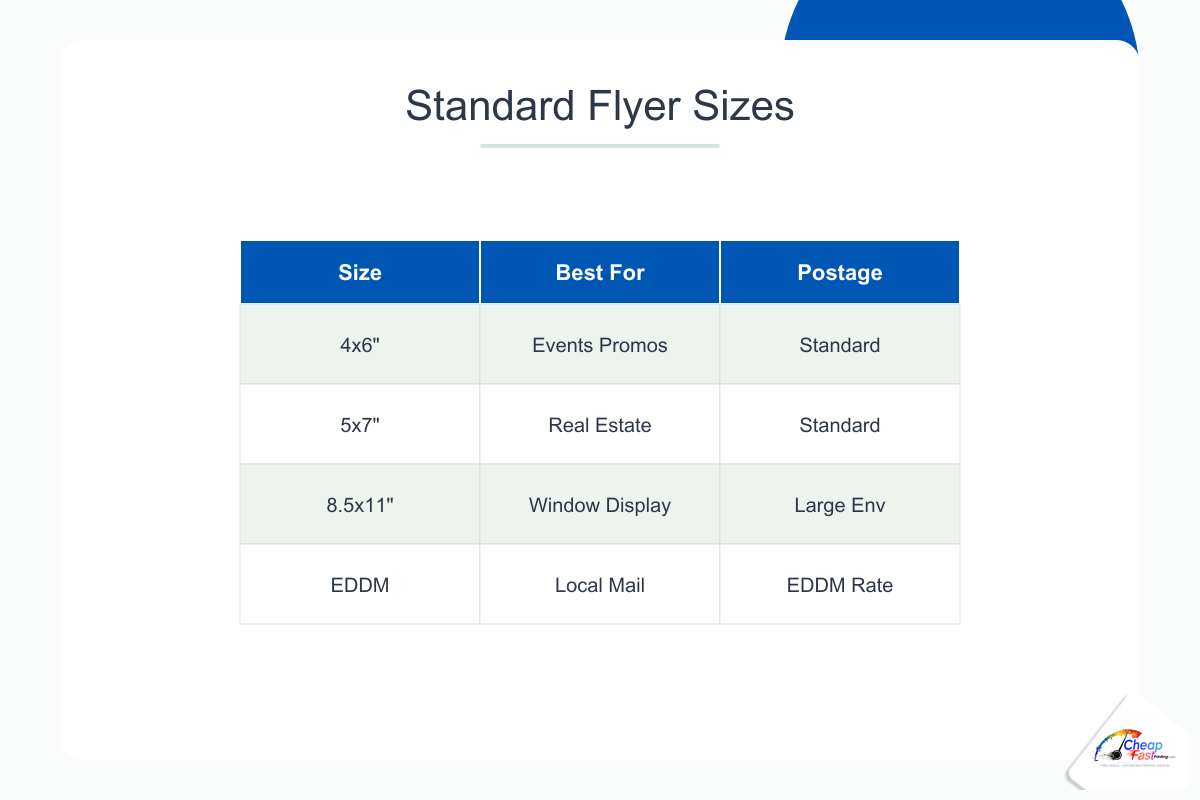
Standard flyer sizes and when to use each
4×6 inch flyers (postcard-style)
The 4×6 flyer matches the classic postcard footprint Americans recognize in the mail and in hand. Use it for event dates, limited-time coupons, QR-to-menu campaigns, and trade-show handoffs. Layout discipline matters: one photo, one headline, one action. If you need three paragraphs of terms, step up in size.
Postal note: 4×6 can qualify for postcard postage when design and addressing meet USPS rules. Always confirm current specs with your mail house before presorting 10,000 pieces.
5×7 inch flyers (versatile middle)
5×7 flyers are the sweet spot for salons, gyms, photographers, and real estate flyer programs. You gain roughly 40% more area than 4×6 without carrying letter-size bulk. Listing photos read clearly; service menus can show six to eight bullets without shrinking type below comfortable reading size.
8.5×11 inch flyers (full letter)
The 8.5×11 flyer is the default when education is the goal: job postings, clinic instructions, school fundraisers, and B2B one-pagers. It fits standard clipboards, office copiers, and wall pockets. For retail windows, pair with bold headlines because passersby decide from six feet away.
8.5×5.5 inch half-page flyers
Half page flyer sizes split a letter sheet in two horizontally. They save budget versus full letter when your message is still multi-line but not full-page dense. Common for insert stacks, bulletin boards, and bag stuffers where height is limited.
| Size (inches) | Best use | Typical copy load | Handout feel |
|---|---|---|---|
| 4×6 | Events, coupons, postcards | Low | Pocket-friendly |
| 5×7 | Services, listings, invites | Medium | Hand-friendly |
| 8.5×11 | Detail, compliance, training | High | Folder or clipboard |
| 8.5×5.5 | Inserts, boards | Medium-high | Lightweight letter cousin |
Rack cards, door hangers, and non-rectangle formats
Rack card dimensions
Rack card dimensions are typically 3.5 x 8.5 or 4 x 9 inches, tall and narrow for acrylic display stands in hotels, visitor centers, and quick-service lobbies. Design vertically: logo top, offer middle, phone and QR bottom. Avoid horizontal logos that shrink to illegible width.
Door hanger size
Door hanger size is often 4.25 x 11 with a die-cut hole for knobs. Keep a clear safe zone around the hole; prepress will reject art that crowds the knock-out. Door hangers excel for local neighborhoods, cleaning services, and political walks where mailbox rules are tighter.
Square and custom shapes
Square flyers (5×5, 6×6) stand out on tables but may cost more in waste on press. Custom die shapes add tooling time. Use them when brand memorability outweighs unit economics.
Cost and value tiers by flyer size
Exact quotes vary by paper, coating, and turnaround. Use these tiers for planning; confirm numbers for your quantity.
| Tier | Typical size | Why price moves |
|---|---|---|
| Volume handout | 4×6, light stock | More pieces per sheet, fast finishing |
| Balanced marketing | 5×7, 100 lb gloss or matte | Mid sheet count, strong photo room |
| Information-first | 8.5×11, heavier stock | Full sheet, more ink coverage |
| Display specialty | 4×9 rack, die-cut door hanger | Custom finishing, less gang efficiency |
Online vs local shop (category view)
Online flyer printing wins on unit cost at mid-to-high quantities because standardized sizes gang efficiently. Local shops win for same-day pickup, walk-in consulting, and odd sizes. Boutiques charge more for brand strategy. Most small businesses get the best value online when files are print-ready (bleed, CMYK, 300 DPI at size) and proofs are approved digitally.
Flyer size: unit cost index at quantity
Tile area reflects relative price pressure; larger trims cost more per piece.
|
4×6100
|
5×7124
|
8.5×11168
|
4×9 rack132
|
Door hanger145
|
|
4×6100
|
5×7118
|
8.5×11155
|
4×9 rack126
|
Door hanger138
|
|
4×6100
|
5×7112
|
8.5×11142
|
4×9 rack118
|
Door hanger128
|
4×6 is baseline at 100. Mail postage is separate.
Choosing flyer size based on how you distribute
Hand-to-hand and street teams
Smaller is better. 4×6 and 5×7 fit palms and pockets. Avoid letter size unless you are handing a full information packet intentionally.
Direct mail and EDDM
Every mail class has size and thickness thresholds. Oversize pieces can jump postage brackets. Design to permitted dimensions and keep indicia zones clear. Consult your mail vendor before locking art.
Counter displays and windows
Rack cards and 8.5×11 posters behind glass need large type and high contrast. Test readability from six feet. Gloss can glare in window light; matte often wins.
Bag stuffers and trade-show bags
Measure the bag. Half-page and 5×7 fit where letter does not. A folded letter is not the same as designing a true half-page with correct margins.
Industry-specific size recommendations
Restaurants and food trucks
4×6 for nightly specials and QR menus; 8.5×11 for catering sheets with package pricing. Lamination helps counter copies survive grease.
Real estate
5×7 for open-house handouts with hero exterior photo; 8.5×11 for feature lists with room dimensions. Match photo resolution to final size (see our DPI guide).
Healthcare and clinics
8.5×11 for instructions with fine print; 5×7 for appointment reminders with large type for accessibility.
Contractors and home services
4×6 for yard signs companion handouts; door hangers for neighborhoods; 8.5×11 for insurance documentation and warranty steps.
File setup: bleed, color, and resolution
Every size still needs 1/8 inch bleed and an inner safe zone. Export in CMYK when your tool allows it. Place photos at 300 DPI at final dimensions. Our bleed guide, CMYK guide, and DPI guide cover the technical steps.
Before a large run, order a small quantity or compare stocks with a sample package so weight and coating match the venue lighting.
When you have picked a size, upload artwork for bulk flyers. Request a proof if color or scale is critical.
Download guideline templates with trim and safe zones matched to your flyer size.
Frequently asked questions
What is the most popular flyer size?
5×7 and 8.5×11 are the most popular for local businesses. 4×6 is common for events and handouts where pocket size matters more than long copy.
Is a rack card the same as a flyer?
Rack cards are a tall, narrow flyer format built for display stands. They use similar stocks and coatings but require vertical layouts and different trim dimensions than 5×7.
What size flyer is best for direct mail?
It depends on postage class and campaign goals. 4×6 postcard formats can be efficient for simple offers; larger pieces stand out but cost more to mail. Confirm size and thickness with your mail house before printing.
Can I use an 8.5×11 design as a 4×6?
Do not shrink a letter layout down. Rebuild with larger type and fewer elements. Otherwise body copy becomes unreadable and photos lose resolution.
What is the standard door hanger size?
Many door hangers are near 4.25 x 11 inches with a die-cut hole. Keep art out of the hole safe zone and follow your printer’s template.
Which flyer size is cheapest per piece?
Smaller sizes often yield more pieces per press sheet, lowering unit cost at the same quantity. Specialty die cuts and heavy coatings raise price more than an extra half-inch of trim usually does.
Should restaurants print menus as flyers or letter?
Short specials and QR menus work on 4×6 or 5×7. Full menus with pricing grids usually need 8.5×11 or a dedicated menu product with folding.
What paper weight is typical for flyers?
100 lb gloss or matte text is common for handouts. Heavier cover weights add stiffness for rack displays. Match weight to how long the piece must survive outdoors or on a counter.