


- Most professionals should order 16pt cardstock for a stiffer, more premium hand-feel.
- 14pt is the practical choice for high-volume teams that reprint often.
- Match finish to lighting: matte for readability, gloss for color pop, soft-touch for tactile luxury.
Business card paper weight changes how trustworthy your brand feels in the first three seconds of a handshake. The right cardstock and business card finishes help colors look rich, keep corners crisp in a wallet, and prevent that thin, homemade feel that undercuts a strong logo. This guide explains points versus GSM, how coatings behave on press, what each weight costs in real terms, and how to pick a combination you will not regret after 500 cards are printed.
What is the best paper weight for business cards?
For most businesses, 16pt cardstock is the best default because it resists bending, survives wallets longer, and supports premium coatings without feeling hollow. Choose 14pt when you need large quantities, frequent design changes, or the lowest cost per card while still looking professional. If your brand is luxury-positioned, pair 16pt with matte or soft-touch lamination rather than default gloss.
Why paper weight matters for business cards
Buyers touch before they read. A light card telegraphs low investment even when your services are premium. Heavier thick business cards create resistance when someone flips the card, which the brain reads as substance and stability.
Weight also changes production behavior. Thicker sheets absorb more ink in solids, handle lamination better, and reduce show-through on double-sided designs. Thin stocks can show the back side in dense color areas, which is a common issue on double-sided photography layouts.
Finally, weight affects logistics. A 16pt box is heavier to ship, but the cards are less likely to dog-ear in bags or trade-show bins. If your team mails cards in envelopes, confirm bend resistance with your printer before a large run.
What is paper weight (pt), and how does it relate to GSM?
U.S. print shops usually quote business cards in points (pt). One point equals 0.001 inch of thickness. A 14pt sheet is roughly 0.014 inch thick before coatings. GSM (grams per square meter) is the metric measure of paper density used in Europe and in many paper mill spec sheets.
Why printers use pt while designers see GSM online
If you research paper online, you may see 300 GSM or 350 GSM card stocks. In practice, many U.S. 14pt coated stocks land near 300–320 GSM, while 16pt stocks are often closer to 350+ GSM depending on coating. Always confirm the mill spec sheet from your printer because coating layers change caliper.
How to compare pt, GSM, and “cover weight” labels
| Label you see | What it means | Typical use |
|---|---|---|
| 14pt | ~0.014 in thick cardstock | High-volume business cards |
| 16pt | ~0.016 in thick cardstock | Premium default for services brands |
| 300 GSM | Metric density rating | Often comparable to mid-heavy card stocks |
| 100 lb cover | Book/paper trade naming | Ask for pt equivalent before ordering |
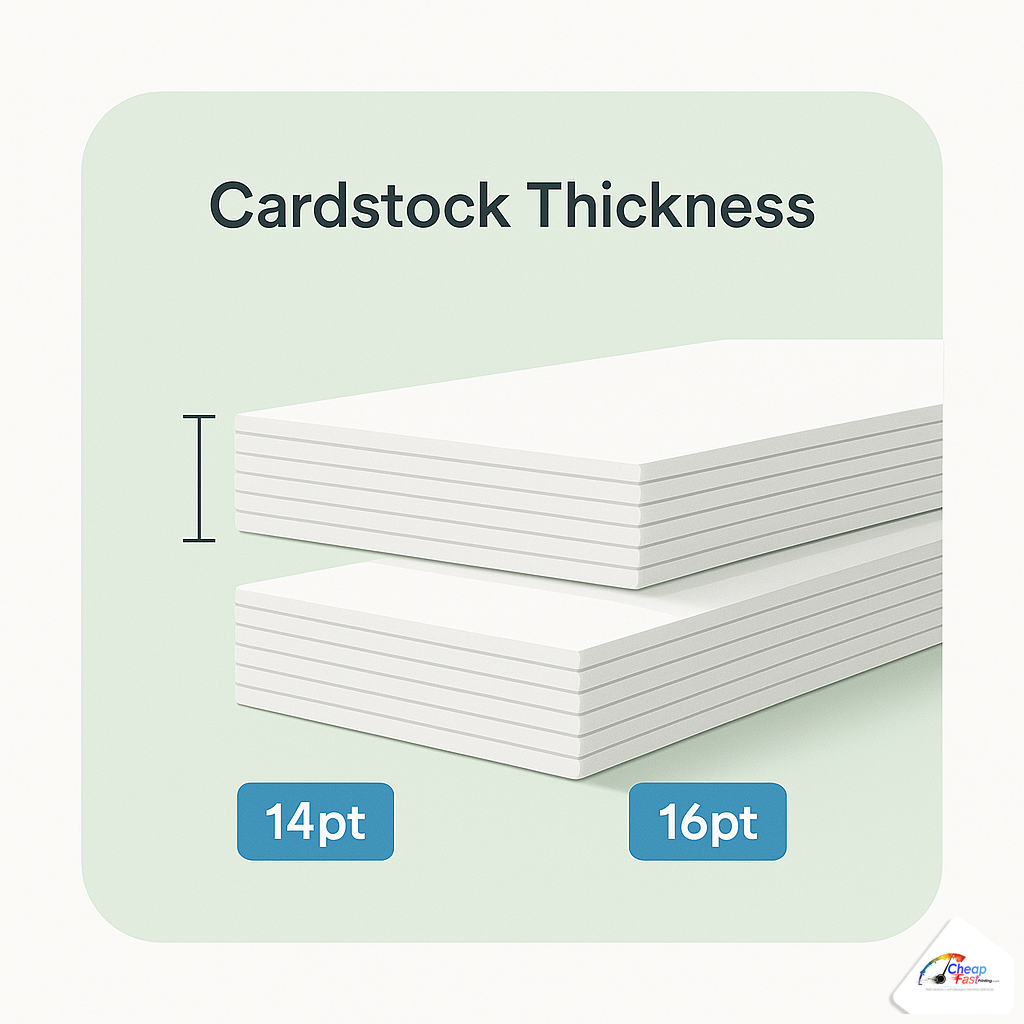
14pt vs 16pt cardstock: side-by-side comparison
Feel, rigidity, and durability
14pt cardstock is the industry workhorse. It is affordable, ships efficiently, and still reads as a real card in most B2B settings. The tradeoff is flex: on large solid-color areas, you may notice a slight bend when someone holds one corner.
16pt cardstock adds noticeable stiffness. For consultants, legal practices, medical offices, and creative studios, that stiffness supports higher perceived rates without changing your actual offer.
| Factor | 14pt | 16pt |
|---|---|---|
| Hand-feel | Professional, lighter | Premium, firmer |
| Show-through risk (double-sided) | Higher on heavy ink | Lower |
| Coating compatibility | Good | Excellent for soft-touch + spot UV stacks |
| Best run sizes | 500–5,000+ | 250–2,500 |
Which industries typically choose each weight
- 14pt: contractors, retail counters, volunteer groups, teams that refresh cards quarterly
- 16pt: attorneys, financial advisors, photographers, salons, architects, executive coaches
How coatings affect print quality (technical basics)
Finish is not only appearance. It is a layer that changes ink holdout, drying, and how light reflects off the sheet.
Uncoated vs coated cardstock
Uncoated stocks absorb more ink, which softens bright colors but gives a natural, writable surface. Coated stocks keep dots sharper, which helps logos and photography. Most “business card paper weight” debates assume coated cardstock because that is what most color business cards use.
Lamination vs varnish vs spot UV
- Aqueous coating: fast protection, light sheen, economical
- Film lamination (matte/gloss/soft-touch): plastic film layer; strongest durability and tactile change
- Spot UV: gloss applied only to selected art; strong contrast on matte or soft-touch bases
On press, heavier film lamination slightly increases total caliper. That is why a 16pt base plus soft-touch can feel substantially thicker than 14pt gloss, even if the raw paper difference is only two points.
Understanding finish options for business cards
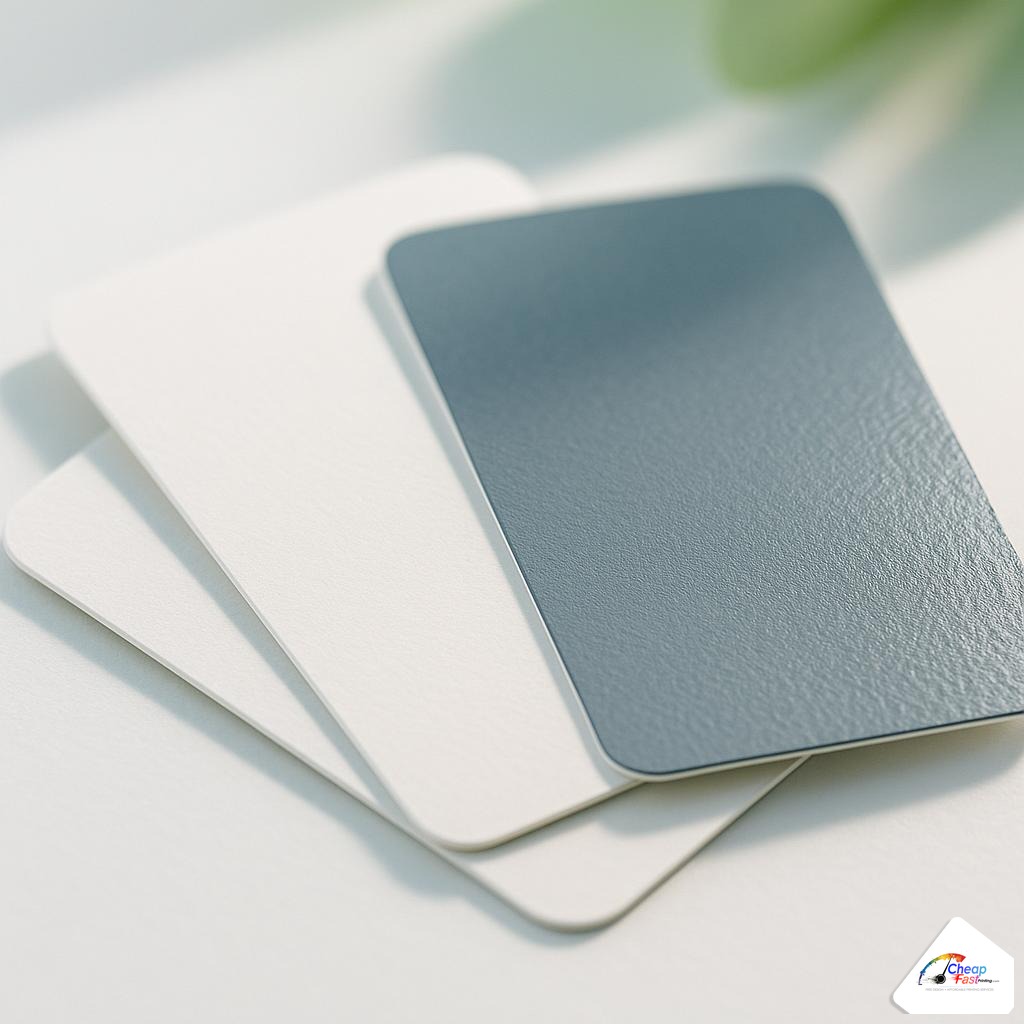
Gloss finish
Glossy business cards increase color saturation because light reflects more directly off the surface. They work well for bold brand colors and photo-heavy layouts. Downsides: fingerprints, glare near windows, and slightly less “quiet” luxury tone.
Matte finish
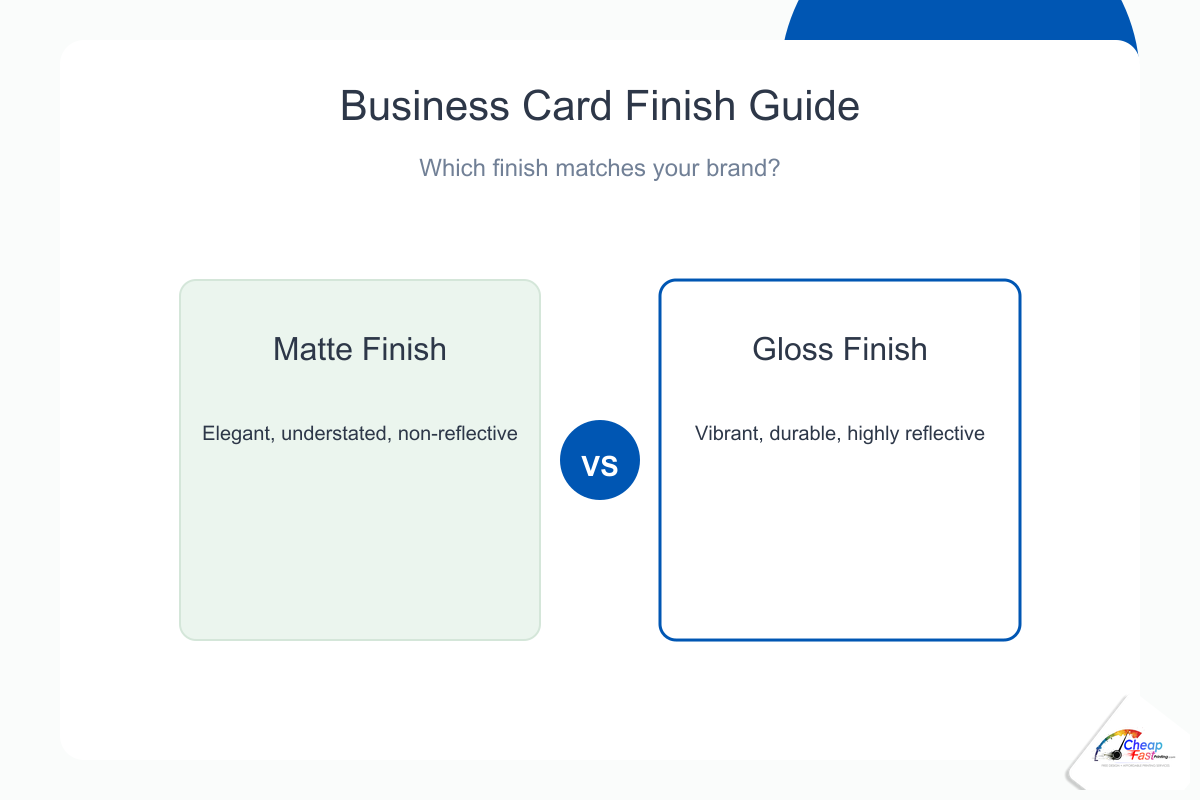
Matte vs gloss business cards is often a brand personality choice. Matte reduces glare, improves readability for small type, and feels modern. It is a strong default for minimal layouts and serif typography.
Soft-touch lamination
Soft touch lamination uses a velvety film that people comment on unprompted. It pairs well with simple logos and generous white space. It is not ideal if you need to write on the card with a ballpoint pen on the front face (see FAQ).
Spot UV and silk lamination
Spot UV business cards highlight only logos or headlines. Silk lamination sits between matte and soft-touch in texture. Both are common upgrades when you want tactile marketing without a full gloss face.
Cost and value tiers (what you are really paying for)
Exact pricing changes by quantity, turnaround, and coating stack. Use these tiers for planning, then confirm quotes for your quantity.
| Tier | Typical setup | Why the price moves |
|---|---|---|
| Economy | 14pt, gloss or matte, standard size | Lower paper cost, fastest press paths |
| Professional default | 16pt, matte or soft-touch | Heavier stock + more durable perception |
| Premium marketing | 16pt, soft-touch + spot UV, special shapes | Extra passes, film costs, die tooling |
Online printing vs local shop vs premium boutique (category view)
Online printers win on unit cost at mid-to-high quantities because of standardized sizes and gang-run workflows. Local shops win when you need same-day pickup, complex consulting, or immediate press checks. Premium boutiques charge more for brand strategy and exotic stocks. For most small businesses, online production with a physical proof step captures 90% of the value at a lower cost per card, provided you review a proof carefully.
Business card stock: relative cost index
Compare 14pt vs 16pt and finish tiers at common quantities. Index 100 = 14pt gloss baseline.
| 100 | 118 | 142 | 168 |
| 14pt gloss | 16pt matte | 16pt soft-touch | 16pt + spot UV |
| 100 | 112 | 135 | 158 |
| 14pt gloss | 16pt matte | 16pt soft-touch | 16pt + spot UV |
| 100 | 108 | 128 | 149 |
| 14pt gloss | 16pt matte | 16pt soft-touch | 16pt + spot UV |
Illustrative index for planning. Live totals depend on quantity, coating, and turnaround. Confirm at checkout.
Matching paper weight and finish to your brand
Scenario: yoga studio (welcoming, tactile)
A studio promoting classes benefits from soft-touch or matte on 16pt. Calm colors, low glare, and a card that feels intentional in a wellness context. Avoid high gloss if your brand voice is grounded and organic.
Scenario: law office (restraint, authority)
Attorneys usually want 16pt matte or soft-touch with minimal color and crisp typography. Spot UV on the firm name only can look sharp without appearing promotional.
Scenario: contractor (durability, volume)
Trades businesses often run 14pt gloss because cards are handed out in volume and replaced seasonally. Gloss survives smudges better in the field than uncoated stocks.
How to test stocks before a large run
Order a small quantity first, or request a sample swatch book. Hold samples under the same lighting as your office reception area. Tilt each card under raking light to see how gloss, matte, and soft-touch change reflection.
When color is critical, approve a physical proof or printed hard-copy proof before the full run. Screen PDFs hide subtle shifts in black density and skin tones.
Quick reference: paper weight and finish decision table
| Goal | Weight | Finish | Best for |
|---|---|---|---|
| Budget volume | 14pt | Gloss or matte | Events, teams, frequent reprints |
| Best value premium | 16pt | Matte | Most professional services |
| Maximum tactile impact | 16pt | Soft-touch + spot UV | Luxury, creative, boutique brands |
| Writable back | 14–16pt | Matte uncoated back or designated panel | Appointments, manual notes |
When you have chosen a direction, upload artwork for business cards. You can request a proof before approving production.
Download guideline templates with correct trim and safe zones for business cards.
Frequently asked questions
What is the best paper weight for business cards?
For most businesses, 16pt coated cardstock is the best default for stiffness and premium feel. 14pt is appropriate for high-volume programs that reprint often and need to control cost per card.
Is 14pt thick enough for professional business cards?
Yes. 14pt is widely used in professional settings, especially where cards are distributed in volume. If your brand is premium-first, 16pt usually creates a stronger first impression for only a modest materials upgrade.
Is matte or gloss better for readability?
Matte and soft-touch finishes reduce glare and help small type stay readable under office lighting. Gloss improves color punch for photography and bold graphics but can reflect overhead lights near windows.
Can you write on the back of soft-touch laminated cards?
Soft-touch film on the front often pairs with a writable back only if the back is uncoated or designed as a writable panel. Tell your printer if staff need to handwrite notes on the back.
What stock is best for double-sided business cards?
16pt coated stock reduces show-through when both sides have heavy ink. If one side is dense photography, ask for a heavier base or adjust ink coverage on the reverse.
Does heavier paper always cost more?
Heavier stocks usually raise material cost, but total price also depends on quantity, turnaround, coatings, and special shapes. At higher quantities, the percent difference between 14pt and 16pt often shrinks.
What is the difference between 16pt and 18pt cards?
18pt is thicker and stiffer, often used for ultra-premium brands. It costs more and may not fit all standard card cases as easily. Many businesses achieve a premium feel at 16pt with the right coating.
Will soft-touch lamination scratch in a wallet?
Soft-touch is durable for normal handling, but sharp keys and abrasive pockets can mark any laminated surface over time. Thicker 16pt bases and darker colors hide wear better than light solids.