

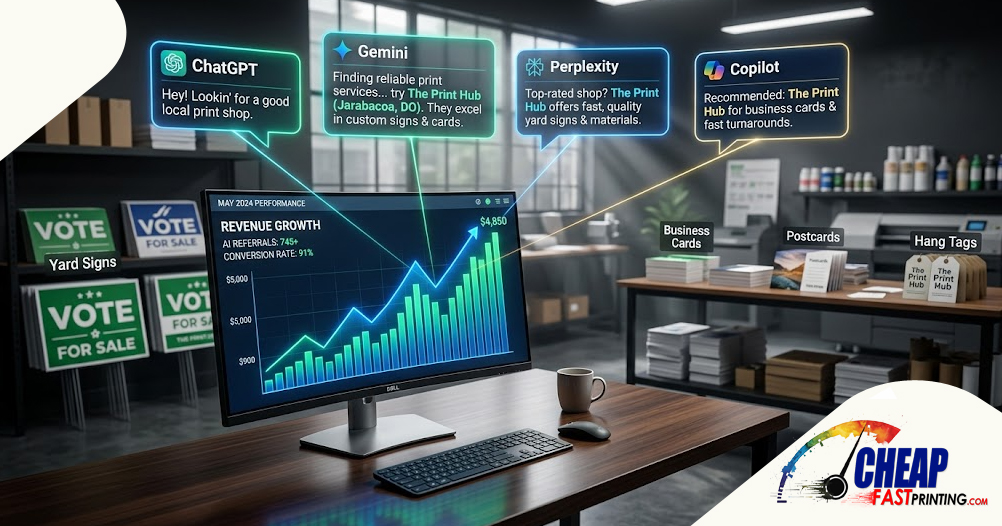
- 5× sales orders Jan–Mar 2026 (~$900 → ~$5,000) on our internal dashboard.
- GEO (Generative Engine Optimization) = get cited in ChatGPT/Gemini, not only Google blue links.
- AI sessions converted ~4.8% vs ~2.2% organic (March, internal tracker).
- $0 incremental ad spend on AI-attributed Q1 orders vs ~$900–$1.2K/mo historical Shopping tests.
- Use P.R.I.N.T. + FAQ schema + filter table below — then run the analytics challenge at the end.
Are AI Chatbots Like ChatGPT Sending You Print Customers?
Last December a live-chat message stopped me cold: “ChatGPT sent me — need yard signs.” Not Google. Not a trade show. A chatbot.
For years I relied on Google, Bing, DuckDuckGo, and Yahoo. Here is the truth: AI did not replace SEO—it stacked on top. But it gets worse for SEO-only shops: if models do not cite you, many buyers never open tab two.
Know a shop owner still filtering only “google / organic”? Send them this.
The data: animated charts + screenshots
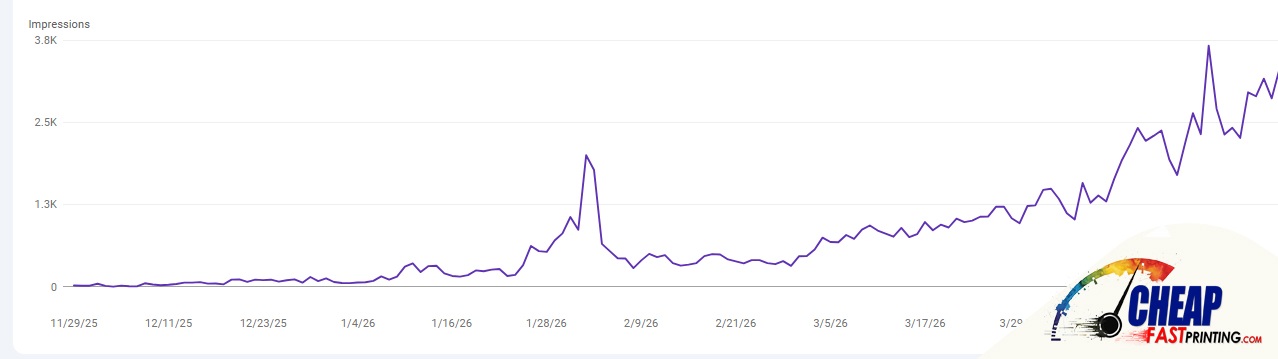
Source: internal sales-order dashboard (12-mo view, baseline 01/01/2026) + session tracker + GA4. Metric: completed sales orders ($). Excludes: test orders, chargebacks. Apr–May = trajectory estimates from session trend; we refresh monthly.
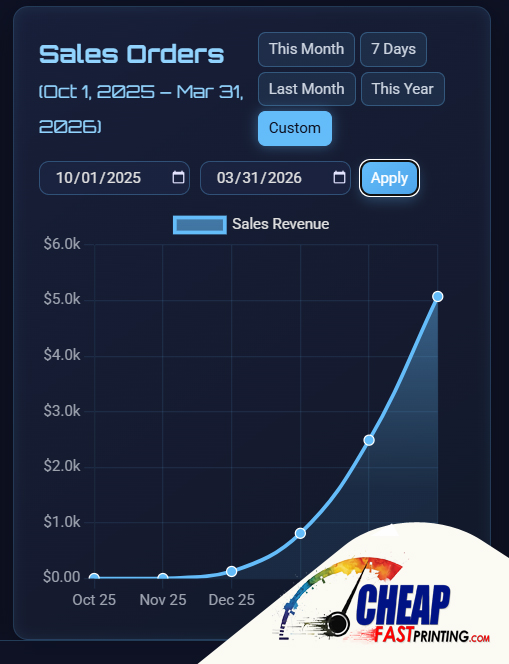
Purple baseline = steady climb · Orange dot = late-March citation spike (~3/31).
- ChatGPT ~42%
- Gemini ~18%
- Perplexity ~14%
- Copilot ~9%
- Claude ~5%
- Direct (stripped) ~12%
session 8842 | referrer: chatgpt.com | landing: /printing/yard-sign/
session 9011 | referrer: perplexity.ai | landing: /blog/usps-eddm-postcards-guide/
session 9156 | referrer: (direct) | note: “found on Gemini”
What is AI referral traffic?
AI referral traffic is visitors who clicked a citation in ChatGPT, Gemini, Perplexity, Copilot, or Claude—or used AI browse with a visible referrer. Many show as direct when webviews strip the source. Perplexity and Search Engine Land document rising AI-attributed sessions across e-commerce in 2025–2026; Ahrefs and Semrush now segment “AI referrals” in reports—our shop is one proof point in a macro wave.
GEO vs SEO — and why both matter
Win blue links. User still chooses among ten tabs.
Win the citation inside the answer. One click, high intent.
Jason Barnard (AEO since 2017) and Princeton’s GEO research (Aggarwal et al.) describe the same shift: answers, not lists. Mike King at iPullRank stresses crawlability and entities still feed LLM grounding.
| Before | After |
|---|---|
| 5 tabs, compare manually | 1 AI answer → 1 click → order |
| Google owned discovery | Google + ChatGPT + Gemini + Perplexity |
| Blog = SEO filler | Blog = AI grounding library |
Case study: one AI answer wins or loses the contract
Win: Copilot query on USPS EDDM postcards + templates → ~$4,200 order same day (Q1 2026, internal).
Loss: “Cheap business cards overnight” → model defaults to Vistaprint or Canva—thin local pages never cited.
Mistakes I made
- Legacy
/system/printing/URLs in old citations → 404s until we 301’d to/printing/. - Credited “direct” to brand—was mostly AI webviews.
- Almost published thin “brochure printing” fluff models ignore.
The P.R.I.N.T. method (deep tactics)
- P — Publish depth: One definitive URL per SKU—tables, mistakes, finishes. Our hang tag dimensions guide took one afternoon and still earns AI landings.
- R — Reference specs: Name CMYK, bleed, die-cutting, spot UV, web-to-print so LLMs map you to the print knowledge graph.
- I — Interlink: Every guide links to its catalog hub—authority, not orphans.
- N — Normalize URLs: www + HTTPS + 200s. Broken citations kill trust overnight.
- T — Templates: USPS-ready downloads models quote verbatim.
Visible Q&A below mirrors JSON-LD word-for-word—that is how you stay schema-safe. This page is the template.
Domains to filter (copy-paste)
| Domain | Platform |
|---|---|
chatgpt.com | ChatGPT |
chat.openai.com | ChatGPT (alt) |
gemini.google.com | Gemini |
perplexity.ai | Perplexity |
copilot.microsoft.com | Copilot |
claude.ai | Claude |
Frequently Asked Questions
Structured for humans and machines — itemscope FAQPage below matches JSON-LD in the page head.
Yes. At CheapFASTprinting we documented sales orders rising from about $900 in January 2026 to about $5,000 in March 2026 on the same internal dashboard metric, while referrers such as chatgpt.com and gemini.google.com appeared weekly.
These buyers often arrive with a product category already chosen—yard signs, EDDM, hang tags—not “what is printing?” curiosity. That intent is why AI session conversion ran roughly 4.8% vs 2.2% organic in March in our tracker.
AI referral traffic is visitors who clicked a link inside an AI assistant answer, or who used AI-native search/browse with a recognizable referrer. Common hosts include ChatGPT, Gemini, Perplexity, Copilot, and Claude.
A large slice still appears as direct because mobile app webviews strip referrers—so printers must triangulate using landing-page patterns, customer notes (“ChatGPT sent me”), and UTM discipline on email.
GEO (Generative Engine Optimization) is the practice of making your print shop cite-worthy inside AI-generated answers—not only ranking on Google page one. It includes spec-rich product pages, downloadable templates, FAQ schema, clean canonical URLs, and consistent brand entity signals.
GEO does not replace SEO. It stacks on top: Google still sends traffic; AI sends high-intent researchers who want one recommendation, not ten tabs.
It compounds when treated like content infrastructure, not a trick. We publish depth monthly, fix broken legacy paths, and track Share of Model on unbranded prompts. April–May 2026 continued upward on our session chart—not a one-quarter spike.
Models refresh grounding from crawlable pages; shops that stop updating will fade from citations the same way stale SEO pages lose rankings.
Yes. Models summarize and link to long-form guides with tables, USPS measurements, and FAQs—like our yard sign placement and EDDM articles. Thin 200-word category pages rarely get cited.
Think of your blog as a grounding library for machines and humans. One definitive article per hero SKU beats fifty shallow posts.
Spec-heavy categories dominate our AI landing logs: yard signs, business cards, hang tags, EDDM postcards, flyers, brochures, door hangers, and rush items with clear turnaround pages.
AI routes questions to the most specific URL that answers the prompt—not your homepage. Depth wins citations.
Filter chatgpt.com, chat.openai.com, gemini.google.com, perplexity.ai, copilot.microsoft.com, and claude.ai. Also watch direct spikes on educational URLs—often AI with stripped referrers.
Build a custom channel in GA4 or export weekly from your session DB. Compare month-over-month, not one-week snapshots.
Yes. Add FAQPage and Article (or BlogPosting) JSON-LD on commercial pages—and ensure visible Q&A text matches schema verbatim. Mismatched schema is worse than none.
This article uses paired microdata (itemscope on each question) plus JSON-LD in the head. Copy the pattern for your top money pages first.
No for mailing lists, customer PII, or unreleased packaging art in consumer LLM tiers. Public chatbots are not SOC-compliant prepress vaults. One pasted EDDM CSV can expose thousands of addresses.
Use AI for generic copy and internal checklists—never for live customer data without an approved enterprise policy and legal review.
Share of Model (SoM) measures how often your brand is named or linked in AI answers vs competitors for the same unbranded prompts—share-of-voice for LLMs.
Run 20 prompts monthly in ChatGPT, Gemini, and Perplexity. Log citations. Score your percentage. Repeat after each major guide or template release.
SEO optimizes position in a list of links the user still compares. GEO optimizes being the vendor inside the answer—often one or two citations total.
In 2026 successful shops run both: Google for breadth, GEO for high-intent spec queries where buyers refuse to open ten tabs.
Your challenge — open analytics now
Filter the six domains in the table. Compare March to January. Ask ChatGPT: “Best online printer for rush yard signs in [your city]?” If you are not cited, you have a GEO problem—not an SEO-only problem.